Play Spider Solitaire online for free
Spider Solitaire is the patience game with two decks and ten columns, where most of the cards start face down and you turn them over one at a time. Your job is to sort the mess into eight tidy runs, each from king down to ace in a single suit. Every finished run is lifted off the table, and when all eight are gone you have won.
This version runs in your browser with no download and no account. Pick 1 suit, 2 suits or 4 suits, drag a card or simply tap it, undo as often as you like, and play full screen on a table with real-looking cards. New games are dealt from a list of deals that a computer has already won, so you are never handed a hopeless one.
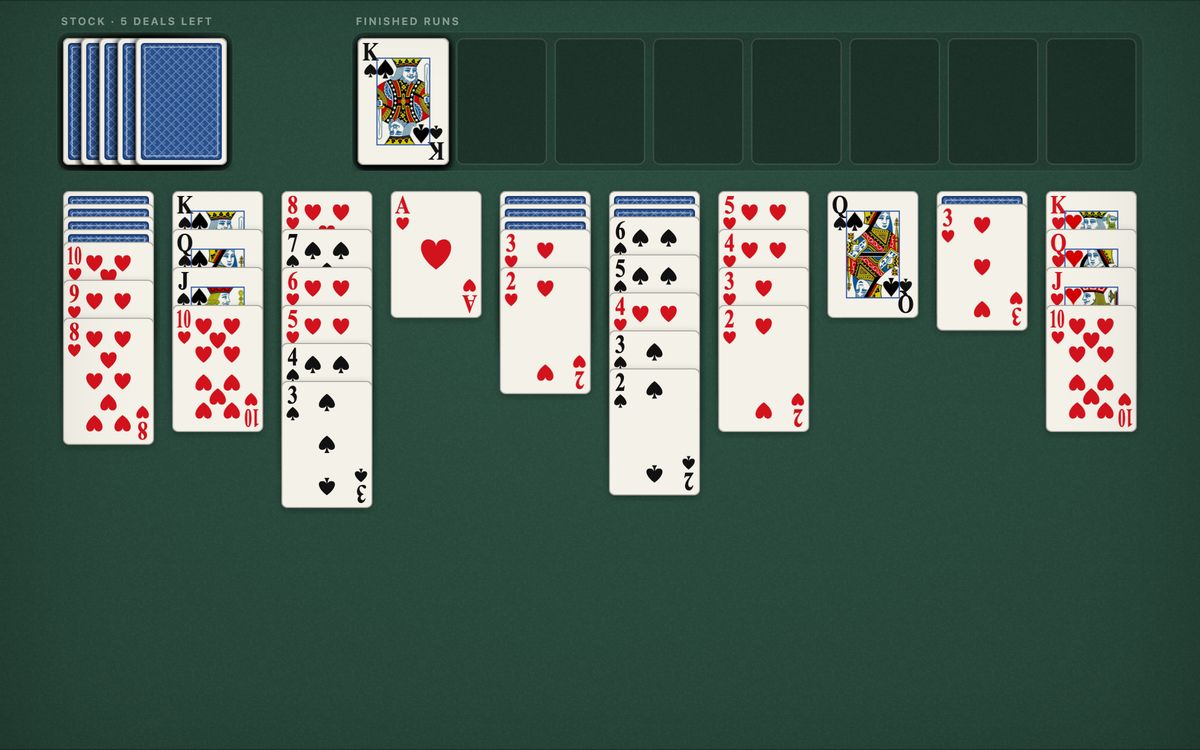
How to play Spider Solitaire
- The deal. 54 of the 104 cards go into ten columns: six cards in the first four columns, five in the other six. Only the last card of each column is face up. The other 50 cards wait in the stock at the top left.
- Move a card onto the next rank up. Any face-up card at the end of a column can go onto a card that is exactly one higher: a 7 on an 8, a queen on a king. The suit does not matter for this.
- Only runs of one suit move together. 8♠ 7♠ 6♠ can be picked up as one piece. 8♠ 7♥ 6♠ cannot: you would have to move the 6, then the 7, then the 8.
- Turn over what you uncover. When a face-down card becomes the last card of its column, it is turned face up. Getting to those cards is most of the game.
- Empty columns take anything. Any card or any run of one suit can start a new column.
- Deal when you run out of moves. Tap the stock and one new card lands face up on each of the ten columns. There are five deals. You may not deal while a column is empty, so put a card there first.
- Finish a run and it leaves. Thirteen cards of one suit in order, king at the top and ace at the end, are taken off the table. Finish all eight and you win.
On this page you can drag a card or a run to where you want it, or just tap it and it goes to the best place it fits. Keys: Ctrl+Z undo, Ctrl+Y redo, D deal a row, H hint, N new game, F full screen.
1 suit, 2 suits or 4 suits
The three levels use the same 104 cards and the same rules. What changes is how many different suits are printed on them, and that changes everything, because only cards of one suit move together and only a run of one suit can be finished.
| Level | The cards | What it is like |
|---|---|---|
| 1 suit | 104 spades | Every run you build can move as one piece. The place to learn the game, and to relax. |
| 2 suits | 52 spades, 52 hearts | You may put red on black to get at a card, but every mix has to be undone later. A real game of planning. |
| 4 suits | Two full decks | Three cards out of four are the wrong suit for the one you hold. Wins are rare and worth remembering. |
Choose the level under the Game # button at the top. Each level keeps its own unfinished game and its own statistics, so you can switch without losing anything.
Winnable deals, and how we know
Shuffle two decks and deal them out, and some Spider games cannot be won however well you play. To spare you those, a solver played the numbered deals first. It is allowed to look at the face-down cards, it gets a few seconds for each deal, and a deal goes on the list only when it has found a complete way to win it.
- 1 suit: of the first 600 deals it won 548.
- 2 suits: it won 526 of the first 600, about 88%.
- 4 suits: it won 442 of the first 1,800, about 25%, within its time limit. Some of the others can surely be won too, but nobody has shown how.
A deal the solver did not win is not proven impossible: it ran out of time. With one suit in particular, nearly every deal can be won.
The New game button and the daily deal only pick from those lists. Knowing a way exists does not make it easy to find: you cannot see the hidden cards, the solver could. If you type in a game number of your own, the page tells you whether that deal is on the list.
Spider Solitaire strategy: 8 tips
- Build in suit whenever you can. A 6♠ on a 7♠ stays movable. A 6♠ on a 7♥ locks the 7 in place until the 6 has gone somewhere else. When two moves both fit, take the one that keeps suits together.
- Turn cards over early. Every face-down card is a move you do not know about yet. Prefer the move that uncovers one, and go first for the columns with the fewest hidden cards.
- Empty a column as soon as you can. An empty column is the only place a card can rest without blocking anything. Use it to take a mixed run apart and put it back in suit.
- Do not fill an empty column in a hurry. The best thing to put there is a king, or a run that starts high: it never has to move again. A stray 4 will just be in the way.
- Tidy up before every deal. A deal drops ten cards on top of everything. Before you tap the stock, make every move that joins suits or uncovers a card, because afterwards those places are buried.
- Move the high cards first. When you can place either a jack or a 5, start with the jack. Runs are built from the top down, and a high card left behind blocks more.
- Kings are a problem. A king can only go into an empty column. A king lying on face-down cards buries them until you have a column to give away.
- Use undo to look ahead. Turning a card over, seeing what it is and taking the move back is allowed here as often as you like. It costs one point each time and often saves the game.
How Spider Solitaire is scored
The score works the way it did in Windows Spider Solitaire:
| What happens | Points |
|---|---|
| You start with | 500 |
| Every move, and every deal from the stock | −1 |
| Every undo | −1 |
| Every finished run, king to ace | +100 |
A win is always worth 1,300 points less one for every move, deal and undo, so a good one-suit game ends somewhere above 1,100. Your best score, best time and win rate are kept for each level on your device.
Game numbers and the daily deal
Every deal has a number, and the same number always deals the same cards. The number of the game you are playing is in the button at the top and in the page address, so you can bookmark a deal, come back to one that beat you, or send it to a friend and compare scores. To play a number, click Game #, type it in and press Play.
The same dialog has the daily deal: one game a day at each level, the same cards for everyone. Your result and your run of days in a row are saved on your device, and you can share your score when you finish.
Where Spider Solitaire comes from
Spider has been played with real cards since at least the first half of the twentieth century. The name is usually explained by the eight runs you have to finish, one for each leg of a spider. For decades it was a game for people with two decks and a large table. Then Microsoft put it into Windows at the end of the 1990s, with one-suit and two-suit levels that made it friendlier, and it became one of the most played computer games in the world.
The Windows version is also why most people call the one-deck game with a stock simply "Solitaire" and this one "Spider". Both belong to the same big family of patience games, along with FreeCell.
More solitaire games here
- Spider Solitaire 2 Suits: spades and hearts, the level most people settle on.
- Spider Solitaire 4 Suits: the full two decks, one of the hardest solitaire games there is.
- FreeCell: every card face up from the start and every deal winnable.
- FreeCell Two Decks: the same 104 cards as Spider, all in view, with eight free cells.
For something other than cards, try Minesweeper, where no board ever forces a guess, or the Water Sort Puzzle, which rewards the same habit of freeing a space and then using it well.
FAQ
Is this Spider Solitaire free?
Yes. It runs in your browser for free, with no download and no account, on a computer, tablet or phone. Your games, settings and statistics are saved on your device.
How do you play Spider Solitaire?
Move cards onto cards one rank higher to uncover the face-down cards. Cards of the same suit in order move together. Build a run from king down to ace in one suit and it is taken off the table. When you have no more moves, deal ten new cards from the stock. Finish eight runs to win.
What is the difference between 1, 2 and 4 suit Spider Solitaire?
The rules are the same, only the cards differ. With 1 suit all 104 cards are spades, so every run moves as one piece. With 2 suits half are spades and half hearts. With 4 suits you play two full decks, and it is far harder because only cards of the same suit move together.
Can every game of Spider Solitaire be won?
No. Some shuffles cannot be won however well you play. On this page the New game button only deals games that a solver has already won: 548 of the first 600 deals with 1 suit, about 88% with 2 suits and about 25% with 4 suits.
Why can't I deal new cards in Spider Solitaire?
You may not deal from the stock while a column is empty. Move any card or run into the empty column first, then tap the stock. This is the classic rule, and it stops you from saving an empty column through a deal.
What is the difference between Spider Solitaire and regular Solitaire?
Regular Solitaire, also called Klondike, uses one deck and seven columns, builds in alternating colours and moves cards to four foundations one at a time. Spider uses two decks and ten columns, builds runs inside the columns, and a run only leaves the table when all thirteen cards of one suit are in order.
How is Spider Solitaire scored?
You start with 500 points. Every move, every deal and every undo costs 1 point, and every finished run from king to ace earns 100. A win is worth 1,300 points minus the moves you needed.
Can I play Spider Solitaire full screen?
Yes. Open Options and choose Full screen, or press F on a keyboard. The table and the cards grow to fill the screen. Options also has other table colours and a four-colour deck.
What does the Hint button do?
It shows a move worth making, judged only from the cards you can see: joining cards of one suit, turning over a face-down card or emptying a column. Press it again for the next idea. When nothing useful is left, it tells you to deal.