Play Baker's Game online
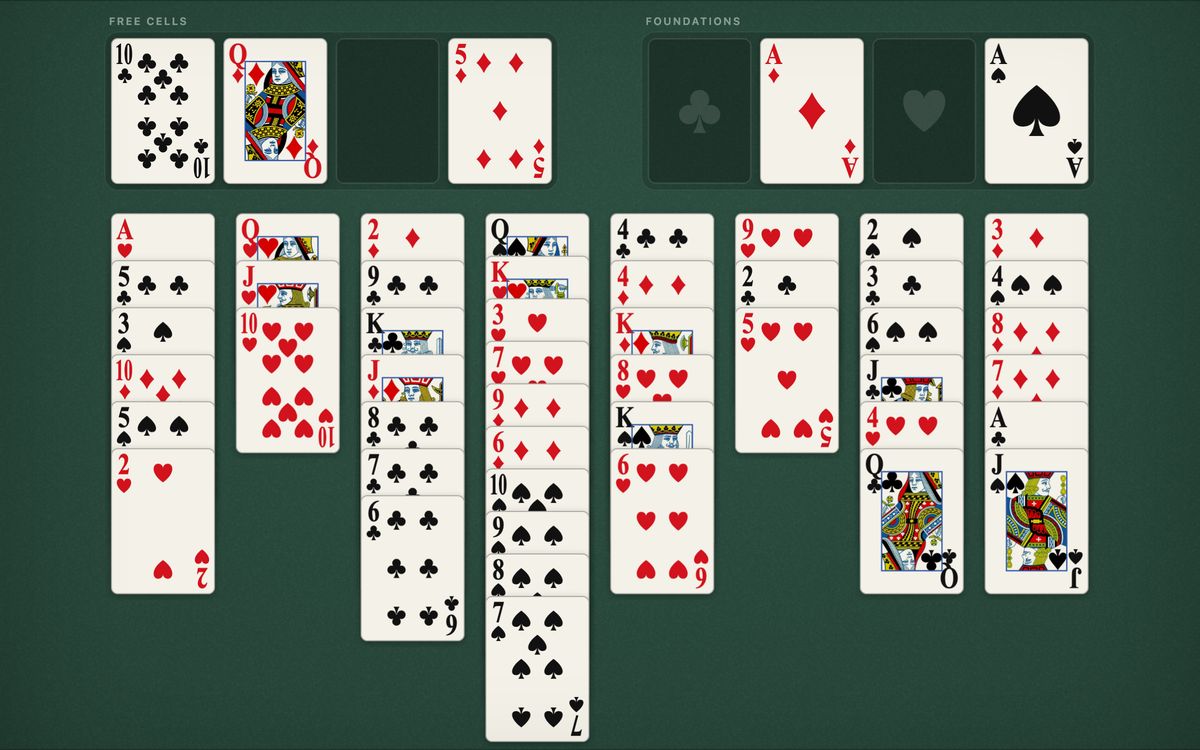
Baker's Game is the solitaire that FreeCell came from. The table is exactly the same: eight columns of face-up cards, four free cells and four foundations. One rule is different, and it changes everything: columns are built down in the same suit, not in alternating colours. A red 6 can no longer go on either black 7. The 6 of hearts goes on the 7 of hearts and nowhere else.
That makes Baker's Game a real step up from FreeCell, and it means many deals cannot be won at all. This page takes care of that for you: the New game button only deals games with a solution. You also get unlimited undo, a Hint button backed by a solver, and a warning when your position can no longer be won.
Baker's Game rules
- The deal. All 52 cards are dealt face up into eight columns: seven cards in the first four, six in the last four.
- The goal. Build the four foundations up in suit from ace to king.
- Columns build down in suit. A card can go only on the next higher card of its own suit: the jack of spades on the queen of spades.
- Four free cells each hold one card.
- Empty columns take any card or run.
- Runs move together when the cards are one suit in order and there is room to move them one by one: (empty cells + 1), doubled for each empty column.
Why Baker's Game is so much harder than FreeCell
In FreeCell every card has two cards it can sit on: a red 6 fits both black 7s. In Baker's Game it has one. Half of the moves you rely on in FreeCell simply do not exist, so the free cells fill up faster and stay full longer.
The numbers show it. In FreeCell, 99.999% of deals can be won. In Baker's Game it is roughly three deals in four: a solver that played the first 4,000 numbered deals here found a solution for 76% of them. A strong player wins far fewer than that at the table, because the winning line is often narrow.
The same number always deals the same cards, so you can type a game number under the Game # button to replay a deal or share it. For numbers you type in yourself, the game tells you if the solver found no way to win.
Baker's Game strategy
- Plan the whole opening. You have at most four parking spaces and very few natural moves. Before the first move, decide which column you are going to empty and count the cells it costs.
- An empty column is everything. It is the only place that accepts any card. Get one early and keep one open as long as you can.
- Runs in suit are free. Once the 9, 8, 7 of diamonds are together, they will all go to the foundation one after another as soon as the 6 is up. Building them costs nothing later, unlike a mixed run in FreeCell.
- Send cards up at once. In FreeCell it can be wrong to play a card to the foundation early. Here a card on its foundation is never needed again in the columns, so nothing is lost.
- Watch for a low card under its own suit. The 3 of clubs under the 9 of clubs in the same column means the 9 has to be moved somewhere else first, and it has only one home. Spot these knots first.
- Undo freely. The game is open information; trying a line and taking it back is the normal way to find the solution.
Where the name comes from
The game is named after C. L. Baker, a mathematician who described it to Martin Gardner. Gardner published it in his Mathematical Games column in Scientific American in June 1968. Ten years later Paul Alfille changed the building rule to alternating colours for a computer version, and called the easier, friendlier result FreeCell.
More games in the FreeCell family
- FreeCell: the classic with one deck, four cells and alternating colours. Every deal can be won, and the Windows game numbers work.
- FreeCell Two Decks: 104 cards, ten columns and eight cells. Longer, roomier and very relaxing.
- Eight Off: eight cells, columns built in suit and only kings in empty columns.
FAQ
What is Baker's Game?
A solitaire card game with the same layout as FreeCell: eight columns of face-up cards, four free cells and four foundations. The difference is that columns are built down in the same suit instead of alternating colours.
What is the difference between Baker's Game and FreeCell?
Only the building rule. In FreeCell a card goes on the next higher card of the other colour; in Baker's Game it must be the next higher card of the same suit. FreeCell was created from Baker's Game by changing that one rule.
Why is Baker's Game so hard?
Each card has only one card it can be placed on instead of two, so there are far fewer moves and the four free cells fill up quickly. About one deal in four cannot be won at all.
Can every Baker's Game deal be won?
No. Roughly 75% of deals have a solution. The New game button on this page only deals games that a solver has already won, so you always get one that can be finished.
How many cards can I move at once in Baker's Game?
The same as in FreeCell: the number of empty cells plus one, doubled for every empty column. The cards must be one suit in descending order.
Is Baker's Game free to play here?
Yes. It runs free in your browser on a computer, tablet or phone, with no download and no account.